


 Manage booking
Seyðisfjörður and the Norröna ferry: how to get there from Keflavík or Reykjavík

Drive Reykjavik team · 10 min read · September 2026
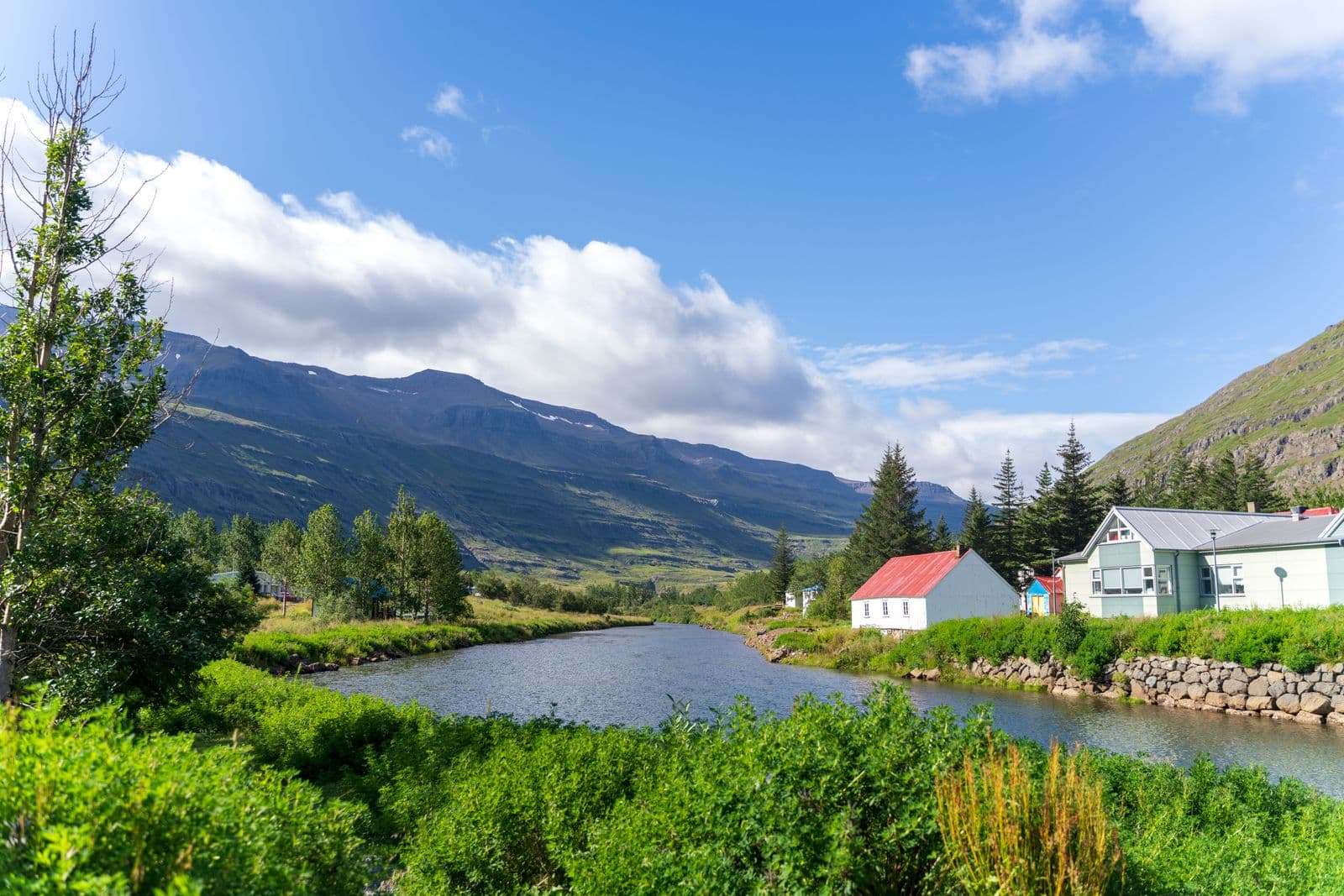
Seyðisfjörður is a small, colourful town at the end of a long, narrow fjord in East Iceland. It is known for its old timber houses, its arts scene and its pale blue church, and it is also the Icelandic port of the Norröna, the car ferry that links Iceland with the Faroe Islands and Denmark. For many travellers, the town is either the first place they see in Iceland or the last.
The challenge is geography. Seyðisfjörður is on the east coast, while Keflavík Airport and Reykjavík are in the far south-west. Whether you are flying in to catch the ferry, or arriving on the ferry and flying home, you need to cross most of the country. This guide explains your options, how long they take and how to time everything around a sailing.
The Norröna ferry in brief
The Norröna is operated by the Faroese company Smyril Line. It sails between Hirtshals in northern Denmark, Tórshavn in the Faroe Islands and Seyðisfjörður in Iceland. Most passengers bring a car, camper or motorbike, which is the main reason people choose the ferry over flying. Foot passengers travel too, and they are the ones who most need to think about onward transport.
The schedule changes with the seasons, and sailings to Iceland are less frequent in winter than in summer. We do not publish ferry times here because they change: always check the current timetable, check-in time and booking conditions directly with Smyril Line before you plan the rest of your journey.
How far is Seyðisfjörður from Keflavík and Reykjavík?
Seyðisfjörður is one of the furthest towns in Iceland from the capital area. By road it is more than 700 km from Keflavík Airport, whichever way you go around the Ring Road. The last stretch, from Egilsstaðir, crosses the Fjarðarheiði mountain pass and then drops steeply down to the town at the head of the fjord.
The northern route
From Reykjavík, Route 1 runs north past Borgarnes to Akureyri, then east past Lake Mývatn and across the highland plateau towards Egilsstaðir. It is a long but well-travelled road, with towns and fuel at regular intervals in the north. Our Akureyri guide and Lake Mývatn guide cover the main stops.
The southern route
The other way follows the south coast through Selfoss, Vík, Skaftafell and Jökulsárlón to Höfn, then up through the Eastfjords to Egilsstaðir. It passes many of Iceland's best-known sights, which makes it popular in summer, but the open sands and the fjord roads can be exposed to strong wind in bad weather. Read our South coast to Höfn and Djúpivogur plan if you want to take it slowly.
Either way, the drive takes a full day without long stops, and many travellers split it over two days.
Your options between Seyðisfjörður and Keflavík or Reykjavík
Fly to Egilsstaðir, then go by road
Egilsstaðir, the main town of East Iceland, has a domestic airport with flights from Reykjavík's domestic airport in the city. The flight takes about an hour. From Egilsstaðir it is a short drive over Fjarðarheiði to Seyðisfjörður, roughly 30 minutes in good conditions.
Remember that international flights land at Keflavík, not at the domestic airport, so you also need to get from Keflavík into Reykjavík. We can take you directly from Keflavík arrivals to the domestic airport with a private transfer; our domestic airport guide explains the details. Leave a generous gap between connections, and check the baggage allowance on domestic flights.
Public buses
Iceland's long-distance buses connect some towns along the Ring Road, but services are limited, change with the seasons and often involve changes and long days. Doing the whole journey from Keflavík to Seyðisfjörður by bus is possible only with careful planning, and it rarely fits neatly with a ferry departure. If you want to try, check the current public bus timetables well in advance, including the local connection between Egilsstaðir and Seyðisfjörður.
Drive yourself
If you are bringing your own car on the ferry, you will of course drive. If you are a foot passenger and want a rental car, check whether the rental company allows a one-way rental between Keflavík or Reykjavík and the East, and what it costs. In winter, only drive if you are confident on snow and ice; our guide to driving in Iceland in winter explains what to expect.
Private transfer, door to door
A private transfer takes you from Keflavík Airport or from Reykjavík directly to your accommodation in Seyðisfjörður or to the ferry terminal, in one vehicle with all your luggage. It is a long day in the car, but there are no connections to miss, and you see the country on the way.
- Fixed price per vehicle: a Tesla or similar for 1–4 passengers, or a Mercedes Vito van for 5–7
- The same price day and night, and the same price in both directions
- At Keflavík, your driver meets you in arrivals with a name sign and checks your landing time from your flight number; 45 minutes of waiting are free
- Stops on the way, for meals or sights, if you agree them with us in advance
- Child seats free on request; pay the driver by card or cash
- Free cancellation up to 24 hours before pick-up; book at least 1 hour ahead
We also drive to Egilsstaðir and other towns in the East. For 8–16 people we can arrange a minibus on request: message us on WhatsApp at +354 777 3949, 24/7.
Timing your journey around a sailing
The ferry will not wait for a late arrival, so build in a margin. These are the points we recommend thinking about.
- Check the check-in time for your sailing with Smyril Line. You need to be at the terminal by then, not at the departure time.
- Count the full journey time, including meal breaks and any sightseeing stops, not only the driving time.
- Allow for weather. Mountain passes and exposed coastal roads can slow you down or close for a while, especially outside summer.
- Consider arriving the day before. Spending a night in Seyðisfjörður or Egilsstaðir before the ferry takes the pressure off and gives you time to see the town.
- Tell us your sailing when you book a transfer, so we can plan the pick-up time with a sensible margin.
Arriving on the Norröna and heading to the airport
If you arrive in Seyðisfjörður as a foot passenger and need to fly home from Keflavík, you face the same distance in reverse. The options are the same: a domestic flight from Egilsstaðir to Reykjavík followed by the trip to Keflavík, public buses where they fit, or a private transfer.
A transfer from Seyðisfjörður to Keflavík Airport costs the same fixed price as the trip in the other direction. Book with your arrival date, and we will agree the pick-up time with you. Because the drive takes a full day, we strongly suggest you do not plan to arrive on the ferry and catch an international flight the same day. Spend a night in Reykjavík or near the airport, and travel to Keflavík the next morning.
If you are driving your own vehicle off the ferry, you are free to take your time. Many people start a Ring Road trip right here; our Ring Road planning guide can help you decide which way to go.
What to see in Seyðisfjörður
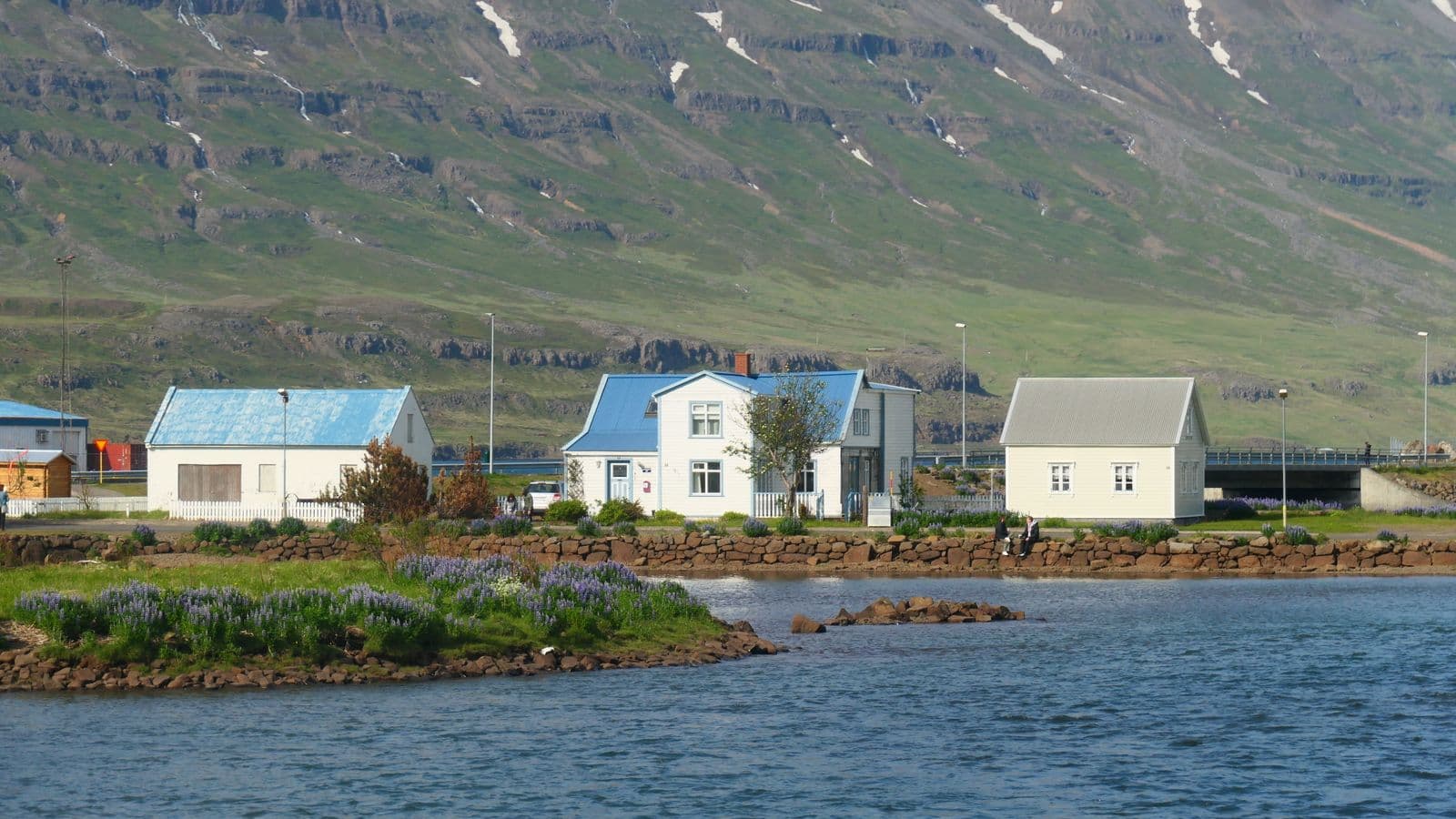
If you have a few hours before or after the ferry, Seyðisfjörður is a lovely place to spend them. The town is small enough to explore on foot.
- The blue church and the rainbow street: Seyðisfjarðarkirkja, a pale blue wooden church, stands at the end of a short street painted in rainbow colours, the most photographed spot in town.
- Old timber houses: many of the town's colourful wooden buildings date from its days as a busy trading and fishing port.
- Skaftfell: a centre for visual art in the town, a sign of Seyðisfjörður's long connection with artists.
- Tvísöngur: a sound sculpture of concrete domes on the hillside above the town, reached by a short uphill walk.
- Gufufoss: a waterfall right beside the road on the way down from Fjarðarheiði, an easy stop on the way in or out.
Egilsstaðir, on the other side of the pass, is the place for larger shops and supplies. Our East Iceland guide covers Egilsstaðir and the Eastfjords in more detail.
Which option is right for you?
Every trip is different, but these rules of thumb help most travellers decide quickly.
- You are travelling light and want speed: fly from Reykjavík to Egilsstaðir and take the short road trip over the pass. Keep a spare day in case the weather delays a flight.
- You have lots of luggage, children or a group: a private transfer keeps everyone and everything in one vehicle, from the airport or your Reykjavík hotel to the ferry or your accommodation.
- You want to see Iceland on the way: go by road with a few agreed stops, or split the journey with a night on the south coast or in the north.
- You are on a tight budget and have time: look at the public bus timetables, accepting that you may need extra nights on the way.
- You are bringing a vehicle on the ferry: you already have your transport; just plan the drive with plenty of daylight and weather margin.
Whatever you choose, the golden rule is the same: do not plan a ferry departure and an international flight too close together. A spare night at either end costs far less, in money and stress, than a missed sailing.
Winter, weather and the Fjarðarheiði pass
Fjarðarheiði is a high mountain pass, and it is the town's only road link with the rest of the country. In winter it can be snowy, icy or foggy, and it may close for a while during storms. The long drive from the south-west to the East also crosses exposed stretches on both the northern and southern routes, and daylight is very short around December.
If you are travelling to the ferry in winter, follow the weather forecast and road conditions closely in the days before. If you are travelling with us and the forecast looks difficult, we will contact you and may suggest leaving earlier or splitting the journey over two days. Our Iceland in winter guide has more general advice.
Frequently asked questions
In Seyðisfjörður, a small town at the head of a fjord in East Iceland, about 30 minutes' drive from Egilsstaðir over the Fjarðarheiði pass.
More than 700 km by road, whichever way you go around the Ring Road. Without long stops it takes a full day, and many travellers split it over two.
Not directly. The nearest airport is Egilsstaðir, which has domestic flights from Reykjavík's city airport. From Egilsstaðir it is a short drive over the mountain pass to Seyðisfjörður.
Not as one direct service. Long-distance public buses cover parts of the route with changes, and timetables vary by season, so check current schedules carefully before relying on them for a ferry.
Check the check-in time for your sailing with Smyril Line and plan to arrive with a good margin. Many travellers stay the night before in Seyðisfjörður or Egilsstaðir.
Yes. A private transfer from Seyðisfjörður to Keflavík Airport costs the same fixed price as the trip in the other direction. Because it is a full day's drive, plan to fly home the next day.
The Fjarðarheiði pass is kept open as far as possible, but it can be snowy, foggy or icy and may close for a while in storms. Check road conditions daily and keep your plans flexible.
Travel tips
More in Getting around Iceland


 Getting around Iceland
Driving in Iceland in Winter: Is It Safe, and When to Get a Driver
Thinking of driving in Iceland in winter? Here is an honest look at snow, ice, wind and short daylight, the checks that matter and when hiring a driver is the smarter choice.
Read more Getting around Iceland
Taxis in Iceland: Prices, Apps and When a Pre-booked Transfer Is Better
How taxis work in Iceland: how fares are charged, how to order one, what to expect from the airport and when a fixed-price pre-booked transfer is the better choice.
Read more Getting around Iceland
Getting Around Iceland Without Renting a Car
You do not need a rental car to see Iceland. Compare buses, domestic flights, tours, taxis and private drivers, and see which option fits each type of trip.
Read more